⚛️ Reactor
Application builders hit a wall when a feature spans the browser and the server: frontend and backend plugin systems usually disagree about discovery, dependencies, lifecycle, compatibility, and enablement. Teams duplicate those contracts, hard-wire optional features into the host, and must coordinate rebuilds and deployments just to add, remove, or replace one capability.
Reactor gives JavaScript frontends and Python backends one extensibility model, inspired by VS Code, Eclipse (OSGi), and other proven plugin systems.
Reactor ships two sibling packages:
| Package | Language | What it is |
|---|---|---|
@datalayer/reactor | TypeScript | A plugin runtime with a framework-agnostic core and a separate React integration. |
datalayer_reactor (imported as reactor) | Python | A FastAPI + pluggy plugin platform for modular extensibility. |
Both tiers implement the same architecture, and that is the point of writing it down once: a host that lists, describes, groups or draws plugins should never have to ask which side of the wire a plugin came from.
Start here
- Why Reactor — what this targets that a hook callback does not.
- Architecture — the nine constructs, and the five diagrams that fix how they relate.
- Get started in TypeScript or in Python.
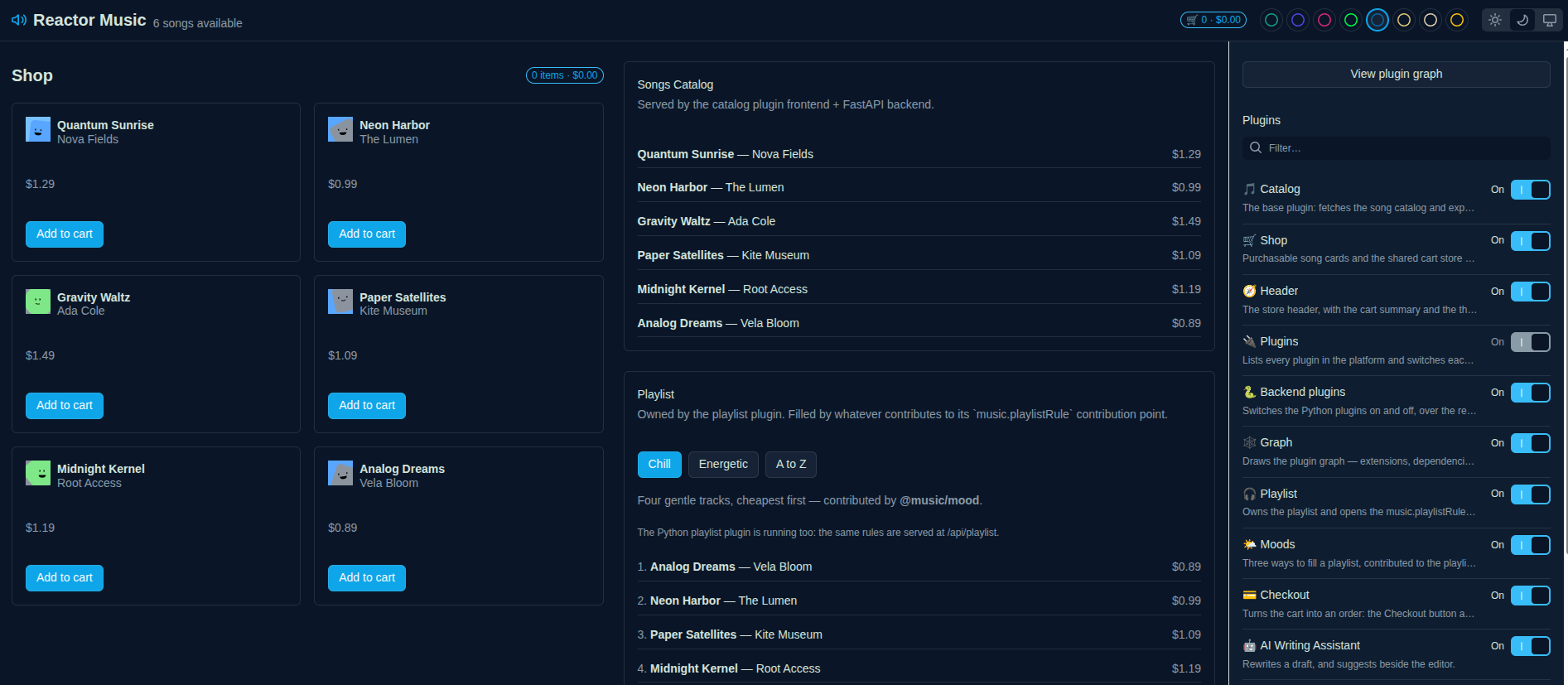
- The music example, running on this page — a store assembled entirely from plugins, with a checkbox per plugin.
- The extensible CLI and the extensible REPL — a command line and an interactive session whose commands come from installed plugins; the Datalayer CLI and the agent-runtimes terminal run on them.
The shape of it, in one diagram
Reactor provides the contribution point; a plugin targets it. Nothing on the Reactor side names the plugin, which is what lets a plugin be added, removed or replaced without the host knowing.
Everything in this documentation
Reactor
Application builders hit a wall when a feature spans the browser and the
Overview
3 items
Getting Started
2 items
TypeScript Plugins
11 items
Python Plugins
8 items
Commands Registry
A command is a named thing somebody can invoke: Play a random song, *Clear the
Cross-tier Dependencies
A plugin usually has a counterpart across the wire, and there are two strengths
Federation
The problem
Python-Packaged Extensions
2 items
Agent Tools
A plugin's commands are what a person does from the palette or a keystroke.
Core Plugins
4 items
Examples
8 items